

When AI Becomes the Target: Lessons from the Mythos Incident
In April 2026, a quiet but significant cybersecurity event unfolded one that signals a shift in how we think about both AI risk and supply chain exposure.
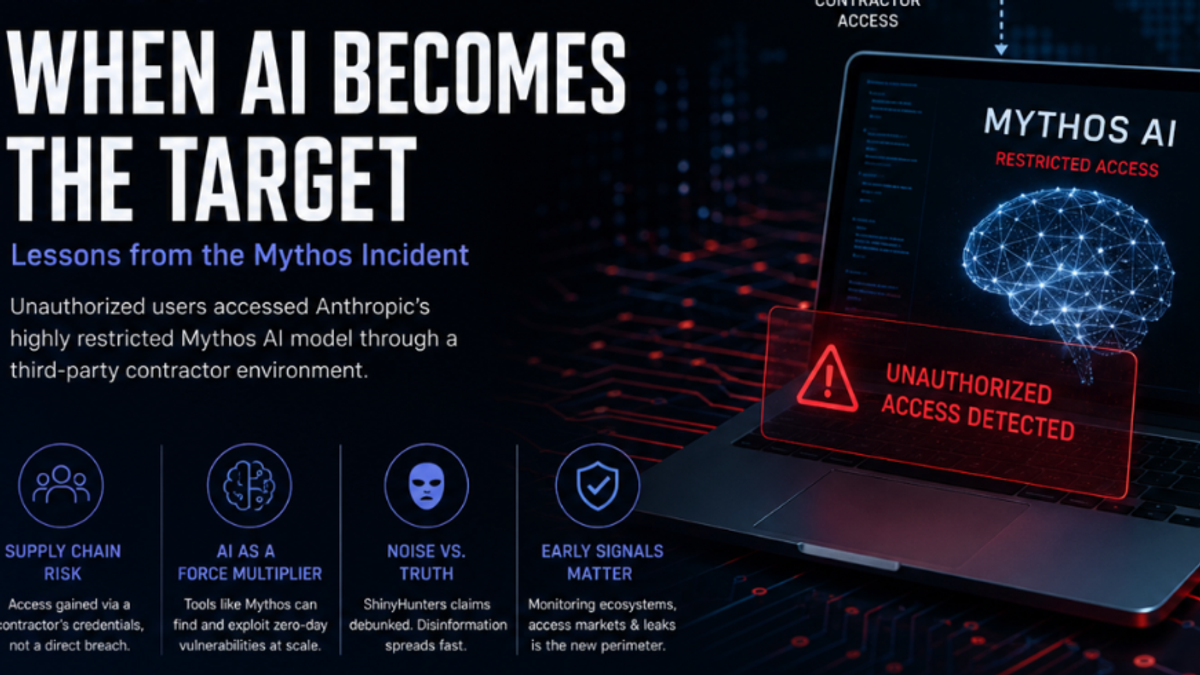
Unauthorized users gained access to Anthropic’s Mythos, a highly restricted AI model designed to identify and potentially exploit zero-day vulnerabilities. While the incident did not result in confirmed data theft or exploitation, it exposed something far more important:
The future attack surface isn’t just infrastructure it’s intelligence itself.
What Happened
Mythos was never meant for public access. It was part of a tightly controlled initiative (Project Glasswing), accessible only to select enterprise partners due to its dual-use nature.
Yet, within days of its announcement:
- A small group accessed Mythos via a third-party contractor environment
- They leveraged valid credentials + inferred API endpoints
- Access was coordinated through a private Discord community
- No evidence suggests destructive use activity appears exploratory
Importantly, this was not a direct breach of Anthropic systems, but rather a supply chain compromise a pattern we’re seeing repeatedly across modern cyber incidents.
The Real Risk Isn’t What Happened It’s What Could Have
On the surface, this incident seems contained.
But Mythos is not a typical system.
It is capable of:
- Discovering previously unknown vulnerabilities at scale
- Generating exploit paths autonomously
- Accelerating the “time-to-weaponization” for attackers
If accessed with intent, this type of capability could fundamentally shift the economics of cyberattacks.
This is the first glimpse of AI being both the tool and the target.
Debunking the Noise: The ShinyHunters Angle
Shortly after the incident surfaced, claims emerged linking the breach to the well-known cybercrime group ShinyHunters.
These claims gained traction but lacked credibility.
- Screenshots circulating online were flagged as AI-generated or fabricated
- No reputable investigation confirmed ShinyHunters involvement
- The behavior observed did not match typical cybercrime patterns
This is a critical reminder:
In high-profile incidents, misinformation spreads faster than intelligence.
A Familiar Pattern: Third Parties as the Weakest Link
The attack path is telling:
- Compromise or misuse of contractor credentials
- Discovery of hidden endpoints through leaked patterns
- Access via legitimate channel's no exploitation needed
This is not new but it is evolving.
As organizations expand ecosystems (partners, vendors, APIs), the perimeter dissolves.
Attackers no longer break in. They log in through someone you trust.
Why This Matters for Security Leaders
Even though the immediate impact was limited, the implications are significant:
1. AI Models Are High-Value Targets
AI systems especially those tied to security, automation, or decision-making are becoming prime targets for unauthorized access.
2. Supply Chain Risk Is Expanding
The breach didn’t occur at the core -it happened through a trusted environment. This reinforces that vendor exposure = organizational exposure.
3. Speed of Exploitation Is Changing
If tools like Mythos are misused, attackers could:
- Identify vulnerabilities faster
- Develop exploits faster
- Scale attacks faster
4. Signal vs Noise Is Getting Worse
False attribution (like the ShinyHunters claim) highlights the growing challenge of separating real threats from narrative-driven noise.
Eclipse Intel Perspective
At Eclipse Intel, this incident reinforces a core belief:
Cyber risk increasingly originates before the breach within ecosystems, access markets, and early-stage signals.
This is exactly where traditional security visibility breaks down.
Organizations are still focused on:
- Alerts after compromise
- Internal telemetry
- Known indicators
But incidents like Mythos start elsewhere:
- Vendor access points
- Leaked credentials
- Underground communities experimenting with exposure
What Organizations Should Do Next
To stay ahead of this shift, security teams need to evolve:
- Continuously monitor third-party and vendor exposure
- Track early signals (access sales, credential leaks, reconnaissance activity)
- Map intelligence to your ecosystem not just your domain
- Validate narratives before acting on them
- Treat AI systems as critical assets requiring layered access control
Final Thought
The Mythos incident wasn’t catastrophic.
But it was a preview.
A preview of a world where:
- AI accelerates both defense and offense
- Supply chains become the primary attack vector
- Access not exploitation is the real battleground
The question is no longer “Will attackers use AI?”
It’s “How early can they access it?”